In the later years of the American Revolution, the British strategy shifted southwards after the Battle of Saratoga, after murmurs of large loyalist support amongst Southerners. The battle ended in an American victory and encouraged the French and Spanish to join the Americans.
The first British action was the capture of Savannah, Georgia, in December 1778. The next year they fended off an attack to retake the city. After that success in Savannah, the British planned to take Charlestown (present-day Charleston) to use as a base. British leaders Sir Henry Clinton and Charles Cornwallis evacuated troops from Rhode Island and brought them to Charleston, leaving a large garrison to defend New York City.
In February of 1780, the British troops arrived south of Charleston. By the next month, they had also taken the area north of the town and by April 1st Charleston was surrounded. On April 18th, a British force of 2500 arrived, including the Queen’s Rangers.
On April 21st, the leader of the American forces in Charleston, Benjamin Lincoln, sent word to the British requesting that his force be allowed to surrender with honours of war. The request was rejected by Clinton. Honours of war refers to a set of privileges afforded to a surrendered military force. They include keeping their colours, allowing the band to play as they march past the victorious force and allowing officers to keep their sidearms and personal baggage.
Over the following weeks, the British closed in on the Charleston fortifications. On May 7th the nearby Fort Moultrie, which guarded the harbour of Charleston was taken. The next day Sir Henry Clinton requested the Americans’ unconditional surrender, but Lincoln again asked for the honours of war.
By May 11th, citizens began asking Lincoln to surrender the town. On that day, the British launched a heated cannonball into the town, starting a fire that burned houses.
On May 12th, Lincoln surrendered the town, leading to the capture of over 5000 prisoners, over 300 artillery pieces, 15 regimental colours and countless other supplies.
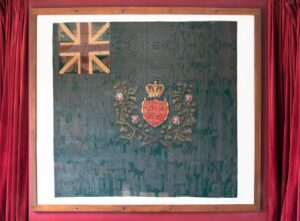
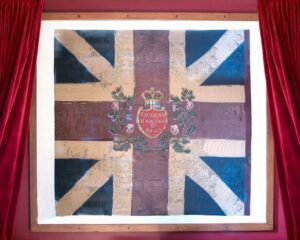
The Siege of Charleston led the Americans to retaliate for the denial of the honours of war following the Siege of Yorktown in 1781. Many of the British units were forced to surrender their colours and arms, except for the Queen’s Rangers, who managed to smuggle the colours out before they could be captured.
Today those colours sit in the Officers’ Mess in the Fort York Armoury.